Lard: the healthy, natural fat.

As a novice pig farmer, I still struggle with my emotions when the time comes for my pigs to head to “the market”. It is not easy for me to send them off and it is very important that I do it for the right reasons. My animals’ lives are full of good food, space to run and play, clean homes and lots of love. The latter makes it great for them, but hard for me.
When their time has come and they have reached market weight, I need to be sure that their gifts and sacrifice are used in every way possible. We keep everything. Organs, feet, ears and back fat. The organ meat we either eat or I feed to my dogs. The feet and ears are reserved for a friend who uses it in his traditional Puerto Rican cuisine. The back fat is rendered into lard.
When the first set of pigs we had raised had reached market weight, my friend had asked me if we were going to keep the fat back. Honestly, I hadn’t even thought of it and had no idea what you would use it for. She explained that it could be rendered into lard and that her grandmother knew how to do it. I had no idea where lard came from, let alone what you would do with it, but I thought it would be great to use yet another part of the animals that I had grown to love so much. I wanted nothing wasted.
A few weeks after the pigs were gone, my friend arrived with a few jars of snowy white lard and a paper lunch bag of crispy bits, cracklings, that smelled awful but tasted delicious.
Ok, now what do I do with the lard? Anything you would normally use shortening or vegetable oil for. So I decide to make brownies. Seemed safe enough, you can’t go wrong with chocolate! I substituted the lard for the vegetable oil and popped them into the oven. Ugh! the smell was awful. That same smell that I disliked about the cracklings, a “piggy” smell that is unlike anything I’ve smelled before, mixed with the aroma of chocolate. I told my son and husband that this lard experiment would most likely be a disaster.
When the brownies were done and cooled, I hesitantly cut one for each of us, fully prepared to taste a “piggy” taste. The were delicious. Moist and chocolatey. Not a hint of the smell could be detected through taste or smell.
Our next experiment was with french fries. I substituted the lard for vegetable oil and heated it to 350 degrees. Again, the “piggy” smell was present, but I was confident it would not be detected in the finished product. I tossed in fresh-cut russet potatoes and fried until they were golden brown. Delicious. Crispy and light. Probably the best french fries I had ever had.
I was sold. I loved the lard and loved that it was another way that I could use all of the animals that I had raised with love. But, my next question was: how bad for me was lard?
I had always thought of lard as a fattening product, used in the old days, before we had learned that fat was bad for you. But as my knowledge of nutrition and technology grew, I was willing to bet that my initial assumption was wrong.
Lard is a natural fat, it comes from an animal with limited processing. Vegetable oil, margarine and shortening are hydrogenated or partially hydrogenated oils. Hydrogenation is a preservation technique that keeps liquid fats solid and also keeps them from going rancid during long shelf lives. Hydrogenated or partially hydrogenated oils are trans fats.
Lard contains 40 percent saturated fat and 45 percent of monounsaturated fat (good fats). Butter, another natural, minimally processed fat, contains 60 percent saturated fat and only 23 percent of monounsaturated.
Lard also has a higher smoking point than other oils, about 350 degrees, so when you fry in it, less oil is actually absorbed into the food.
And here is the biggest selling point of lard. Lard is fat, fat is a necessary component to any healthy diet, in moderation. Fat is converted into fuel and helps the body absorb nutrients, especially calcium and vitamins. Fresh rendered lard from home raised pigs is full of vitamins and nutrients.
Store bought lard is rendered from factory raised pigs and is also hydrogenated or partially hydrogenated. If you are going to give lard a try, be sure to buy it from your local farm or render it yourself!
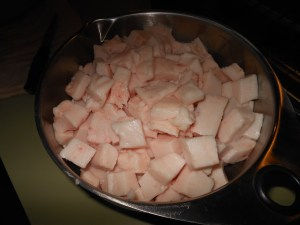
A couple of Sundays ago, my friend and I rendered lard from the second set of pigs. We had the fat back from three pigs, which had been frozen by the slaughterhouse. I thawed the bags of fat back which were cut into large slabs of one inch thick pieces. Because the skin is still on the fat, the first thing we did was cut the skin from the fat with a very sharp knife. Once the skin was removed, we cut the fat into 1 inch cubes. In small batches, we melted the cubes of fat in a large stock pot. When the fat was liquified and only small bits remained, we removed the bits, cracklings, and drained on paper towels.
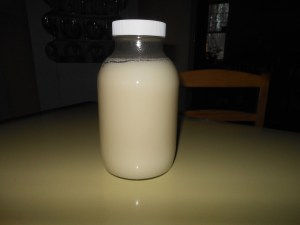
We poured the liquid fat through a cheesecloth lined sieve and let cool slightly. Then we poured the warm lard into sterilized glass jars. Once the lard cooled completely it was snowy white and ready for use. Refrigerate lard indefinitely, but it won’t last that long here!






Comments